
Dear Jane — Chapter 1

The first steps really are the hardest.

I’ve completed three blocks so far—most of them twice—just trying to get a feel for scale, assembly, and how all these tiny pieces are meant to fit together. And let me be honest: I have struggled.

The patterns for Dear Jane aren’t printed in the book; only the finished block graphics are. That means seam allowances, cutting dimensions, and stitching order are all left to interpretation. I’ve been relying heavily on my existing skills to reverse‑engineer each block: sketching layouts, mapping seams, deciding pressing direction, and eventually figuring out how the quilting lines should run.

Graph paper has been my best friend—drawing layout, cutting notes, and quilting direction gave me at least a starting point. Maybe I won’t need this level of detail for every block, but for this first set, it provided the confidence boost I needed.

I also committed to busting my scrap stash for this quilt and drastically underestimated just how much prep that involves: pre‑washing, ironing, and cutting small pieces with precision. Starch has become essential. These blocks are tiny, and even the slightest variation can throw the entire block off, which in turn affects the cumulative size of the quilt.

Block A1: Pinwheel Gone Awry
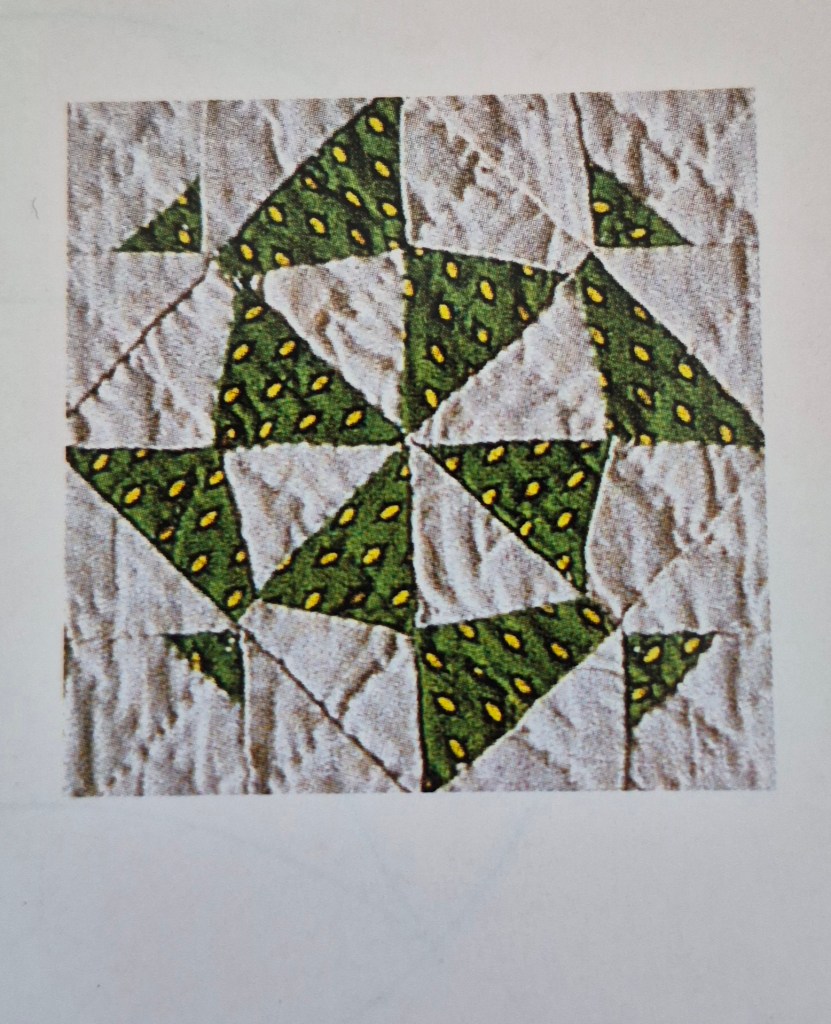
Original Block

Having a plan and a rough layout sketch helped me get started. Is it pretty? No. Is it complete enough for anyone else to follow? Definitely not. But is it enough to get me moving? Absolutely.

And honestly, that’s the whole point. Your work isn’t being graded. As long as your system works for you, it’s good enough.
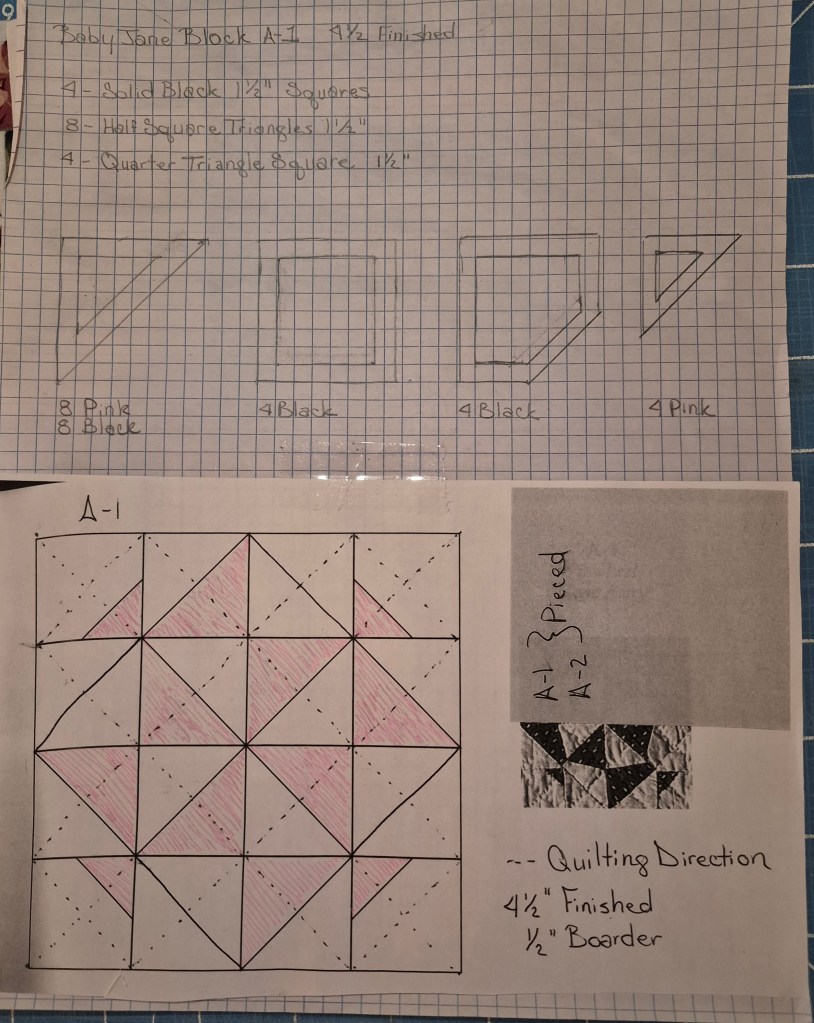
This block is mostly half‑square triangles—and this is where grainline absolutely matters. Cutting them on the bias introduces stretch that can warp the block. Keeping pieces on‑grain wherever possible helps maintain accuracy as you stitch.

Even the width of your pencil marks matters. A 1/32″ variance seems trivial, but across 5,602 pieces it adds up to roughly 43 inches of potential difference over the entire quilt. That means cut‑off points, lost seam allowances, and a quilt that doesn’t square the way you intended.

I promised to be honest with myself—and with you—throughout this process. That means showing the “not quite right” block that came before the correct one. It won’t make it into the finished quilt, but it isn’t wasted. My imperfect blocks will become the foundation for a crazy quilt where the “mistakes” can hide in embellishment and creativity.
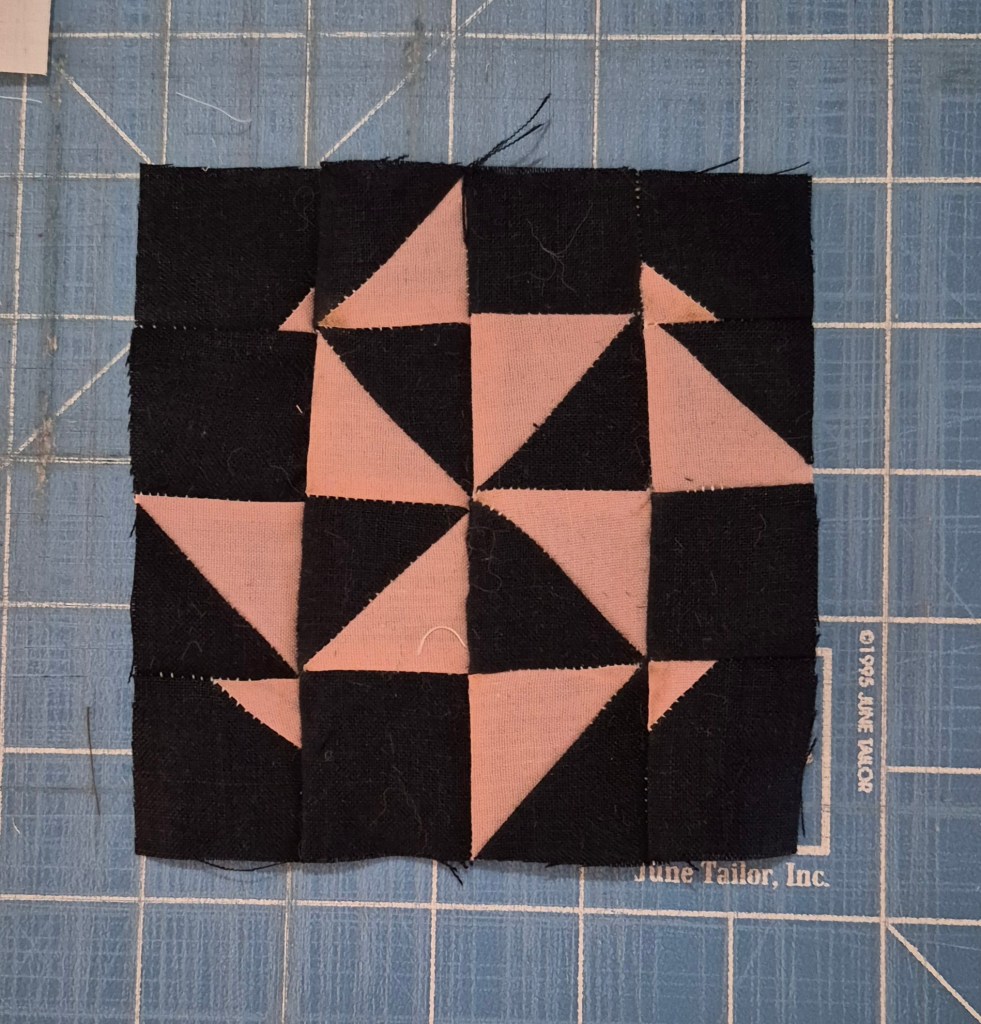
And finally, the first block! Not quite perfect, but definitely some of my best work and one I am proud to share with you.

Block A2: One‑Two Buckle My Shoe

(insert original block picture)
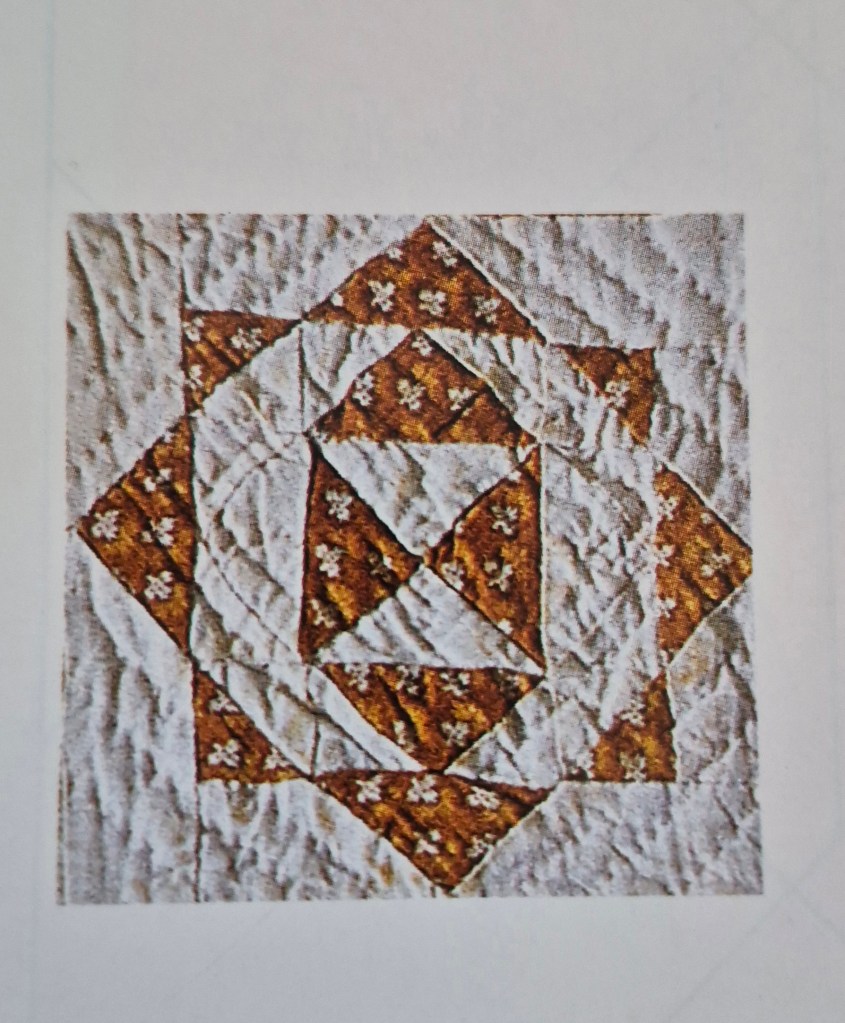
I followed the same approach with this block: layout sketch, notes, reminders of what to do (and what not to do).
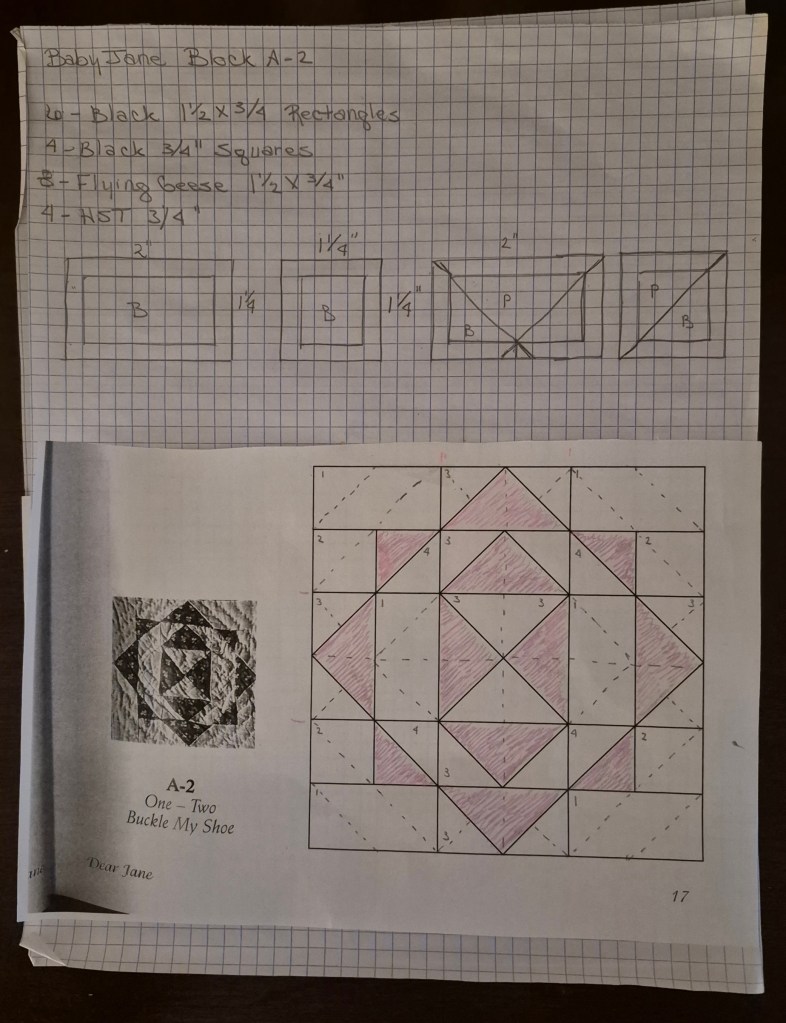
This layout was more straightforward. Or maybe surviving the first block gave me just enough confidence to move ahead boldly.
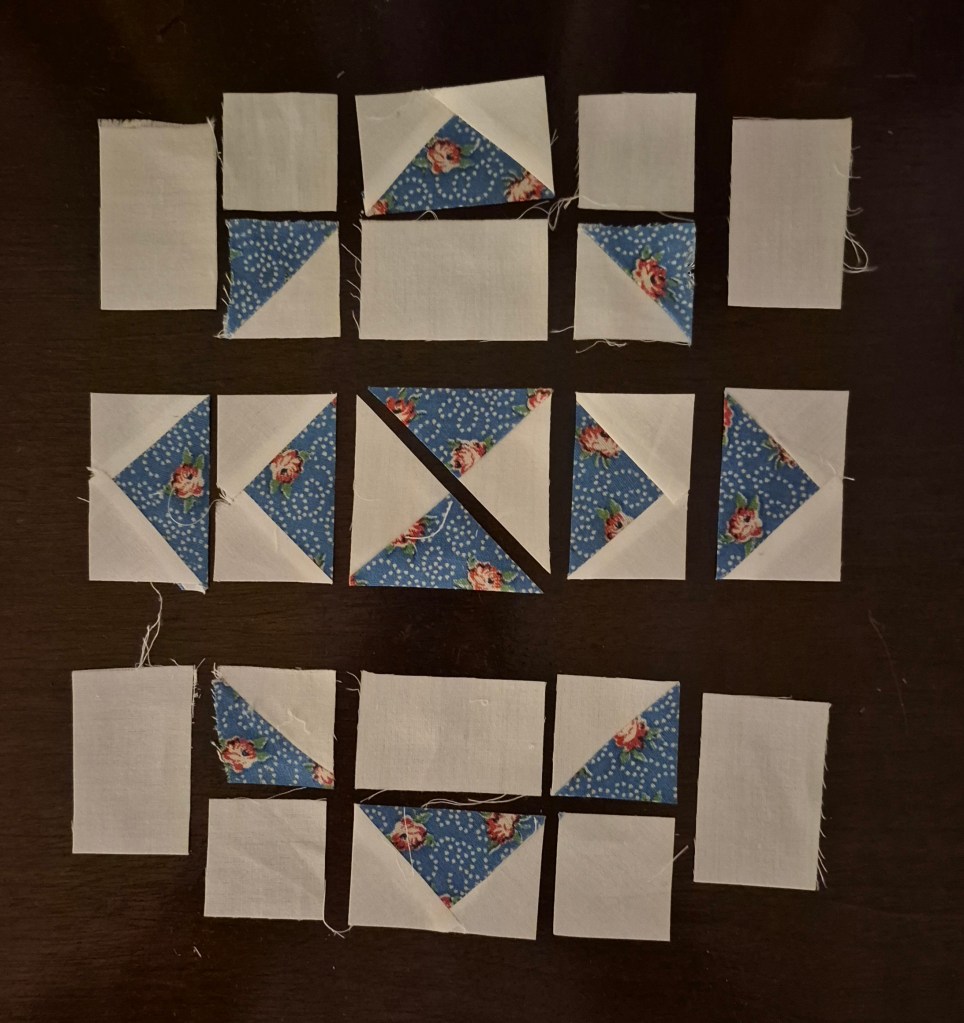
Then came the flying geese. Why I struggled so much with keeping the points is beyond me, but they simply refused to cooperate. So—deep breath. Grace. Patience. A redo. And a reminder of everything I learned from the first mistake.
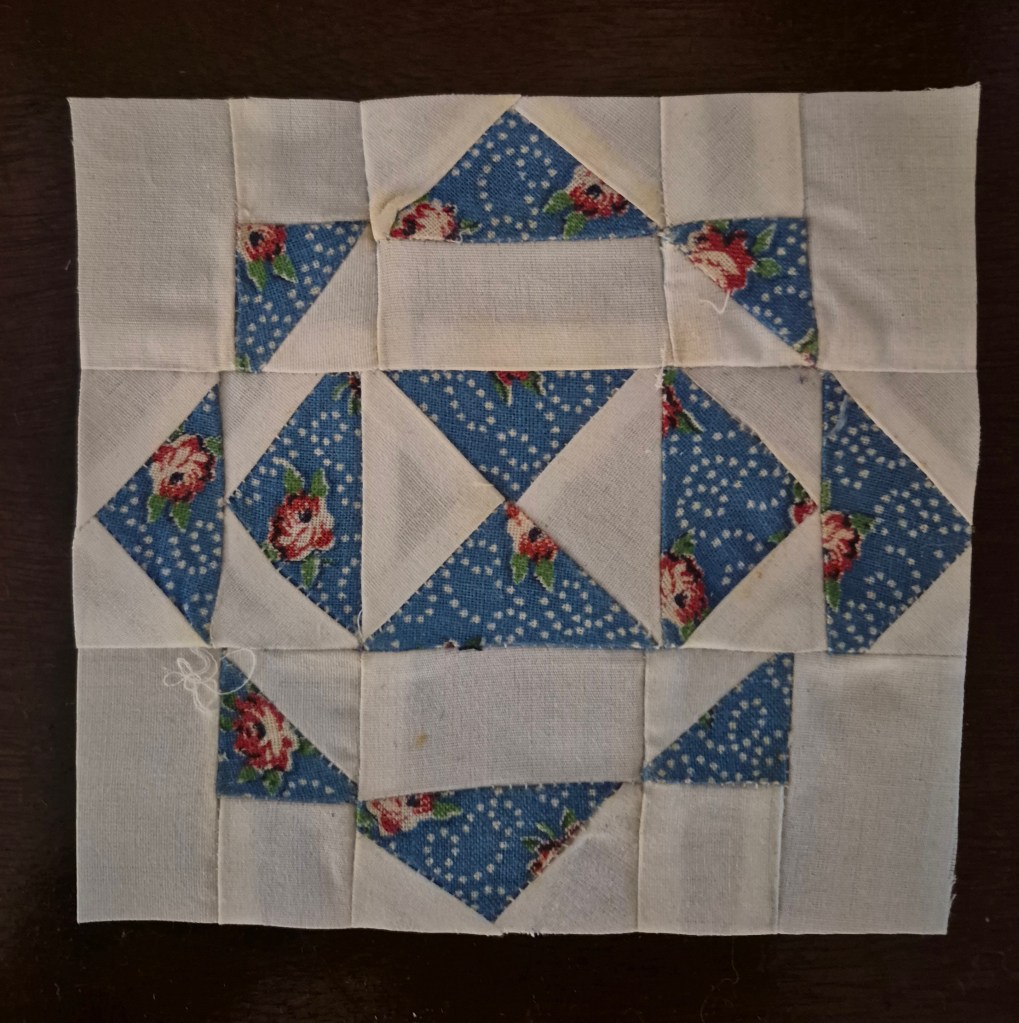
I took a break—a “step away from the sewing machine” moment—to think about my choices. Am I really going to have to make every block twice? How badly do I want this quilt? And why, exactly, did I decide to document this publicly? (A question for therapy, perhaps.)

But revisiting my why whenever frustration hits is what keeps me grounded and moving forward.

And just like that, the second attempt came together with ease and a level of skill I frequently underestimate in myself.
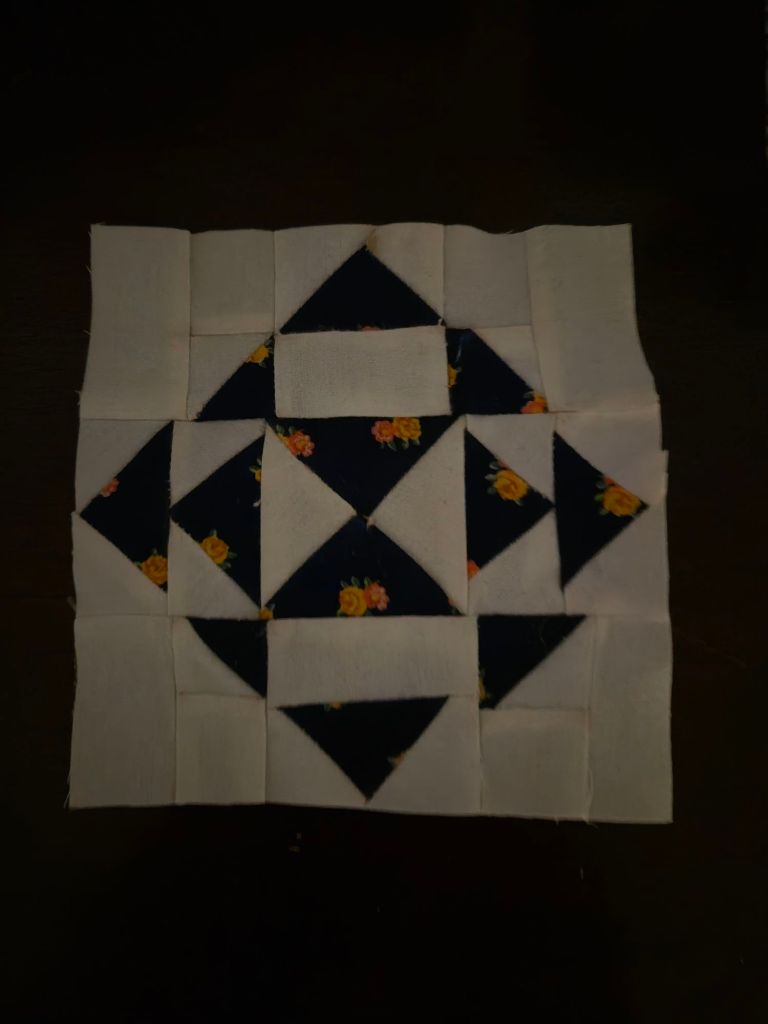
Block A3: Hunter’s Moon
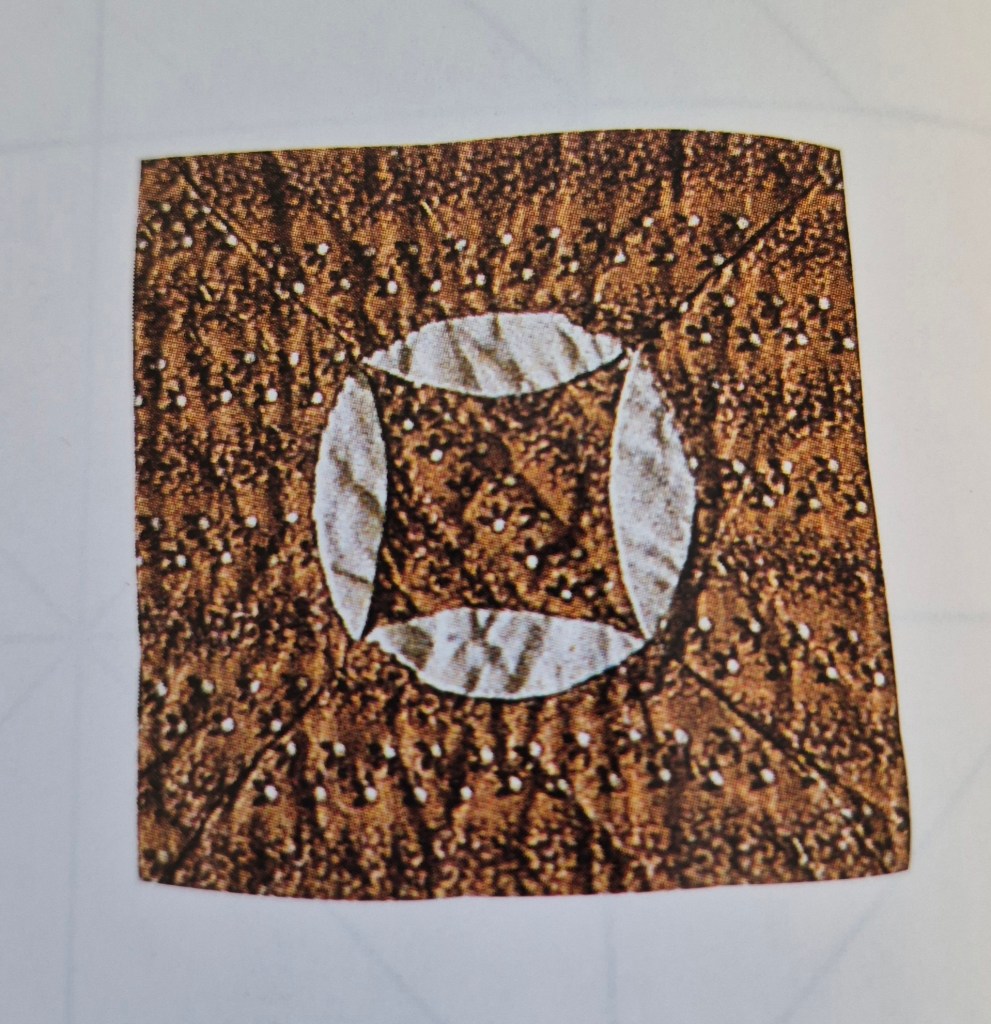
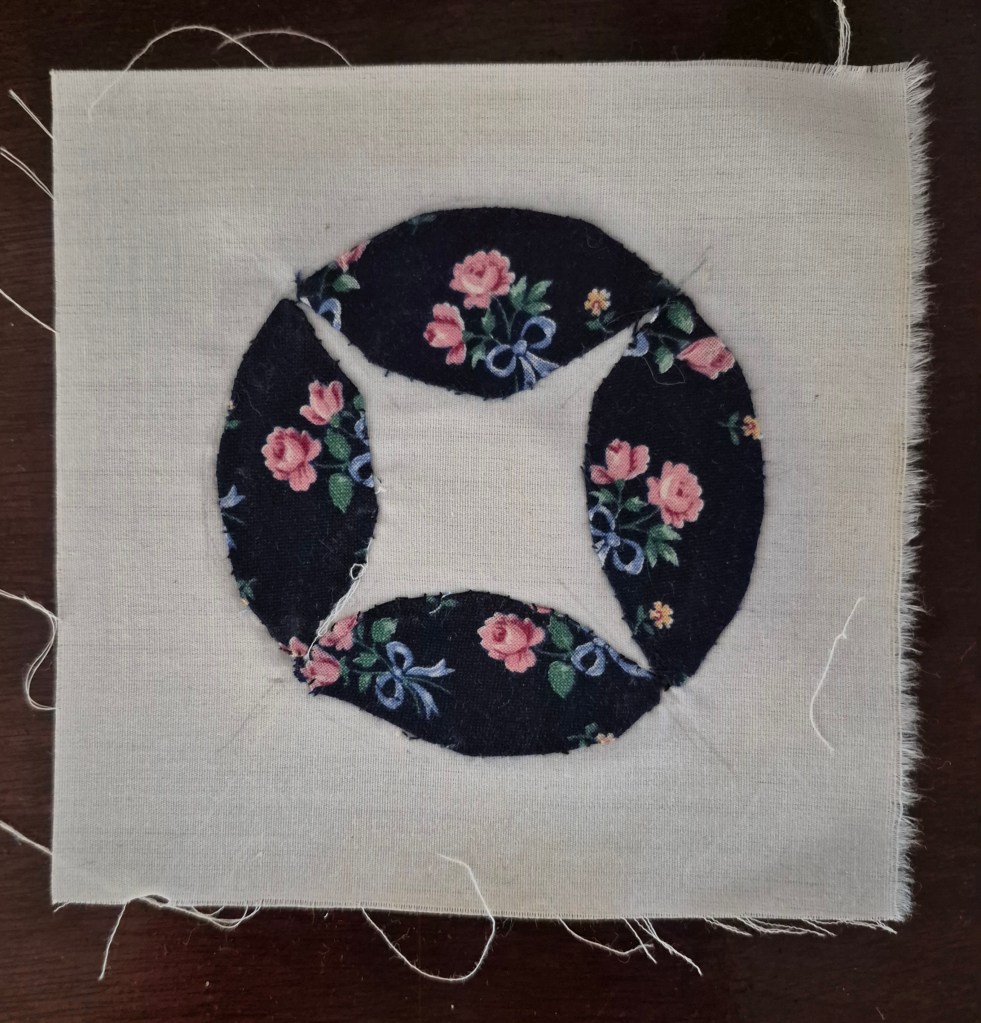
For this block, my mix‑and‑match approach of machine piecing and hand piecing continues. Straight seams? Machine all the way. But Block A3’s curves and appliqué call for handwork. Blind appliqué has always been one of my shakier skills, but the only way to improve is to practice—so that’s exactly what I’m doing.

I kept the same habit of layout sketches and notes to guide me.
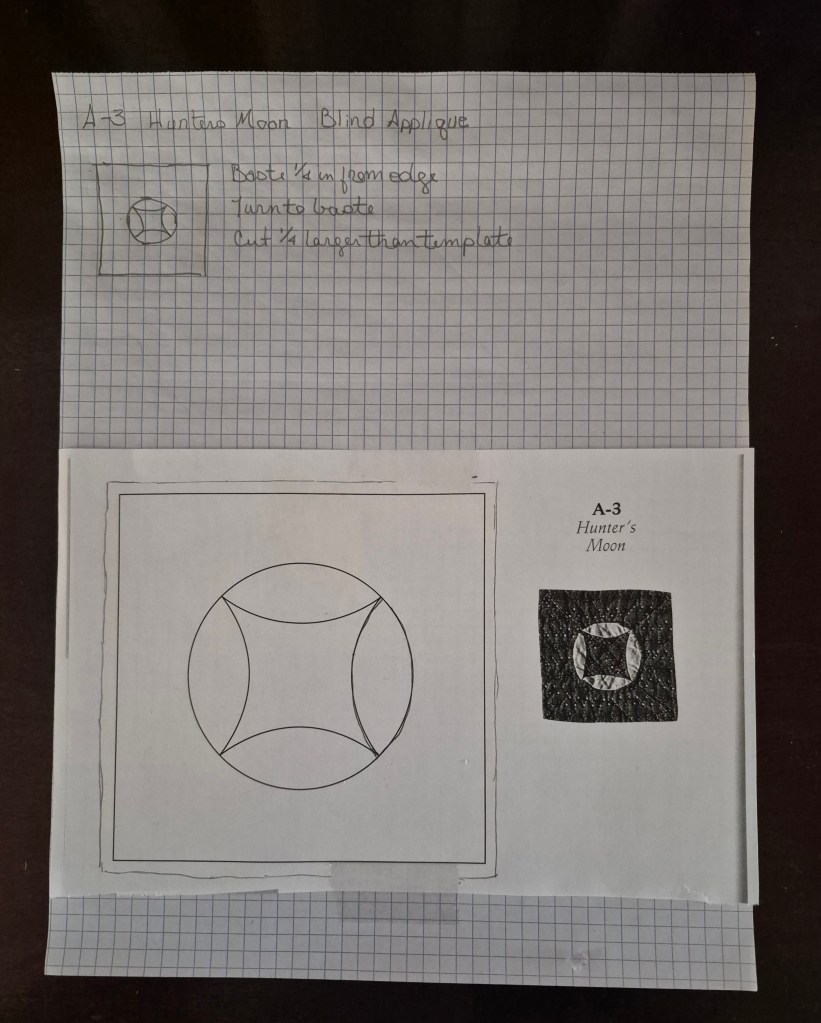
And here’s a delightful twist in the learning process:

The best explanation I’ve ever encountered for blind appliqué didn’t come from a tutorial or a class—it came from a fiction book. The Aloha Quilt by Jennifer Chiaverini includes a beautifully written description of Hawaiian appliqué techniques, from basting to needle‑turning. That passage alone added “learn Hawaiian‑style quilting” to my someday list.

And just like that, the first attempt at Block A3 is one I can truly be satisfied with.
And so, the journey begins.

Slow, challenging, humbling—and absolutely worth it.
Baby Jane

What Am I Thinking?

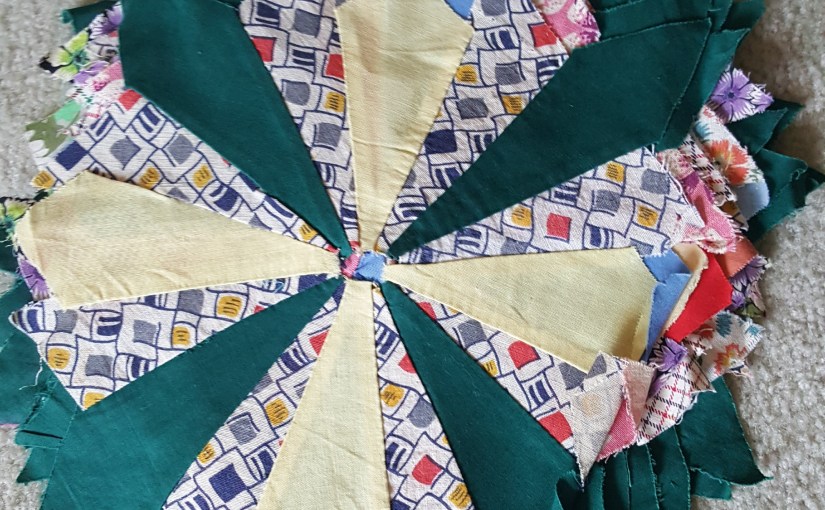
Well… here we go. The Mount Everest of quilting: the Dear Jane. Two hundred and twenty‑five blocks, each measuring just 4½ inches. It’s a test of traditional piecing, English paper piecing, and blind appliqué skills woven together in one iconic quilt. There are many variations on the original, and this one will be mine.

I’m setting out on this journey and inviting you to come along—not only for company, but to help keep me accountable and this project on track. My plan is to group blocks by technique and complete four each week. I’ll be referencing Brenda Manges Papadakis’ chronicle of the quilt and its history. The original was completed in 1863 during wartime and contains 5,602 individual pieces. In the bottom right corner, the maker left her mark, timeless.


My “Baby Jane”

These variations are often called Baby Janes: not quite the original and certainly not period‑correct in technique or materials. Mine will be pink (because PINK) and black. At first, I thought I’d stick to one pink and one black throughout the quilt, but I’ve pivoted. Instead, I’m leaning into my stash and embracing the true spirit of a stash‑buster—meaning no new fabric purchases.


The Fabric–Thread–Needle Trinity

Even while stash‑busting, the quality of your materials matters. Always keep in mind the quilting trinity: fabric, thread, and needle.

  • For 100% cotton fabric, I’m piecing with cotton quilting thread and using a universal needle.
  • For embroidery, I’m using silk thread with a silk needle, so the thread melts into the weave.

Grain line matters—these blocks are tiny, and accuracy is everything. While there isn’t much opportunity for fussy cutting, take time to consider how your print will land in each block.

And now, a hill I will happily die on: Pre‑wash your fabric.

Yes—again for the ones in the back—PRE‑WASH.

I don’t typically pre‑wash quilting cotton, but with blocks this small and this detailed, any bleeding or warping becomes an unnecessary challenge. I recommend pre‑washing in ORVUS (linked on the Shopping page) using cold water.


Precision Is Everything

Precision cutting will make or break this quilt. Being off by just 1/16 of an inch, repeated 225 times, can leave your quilt nearly 7 inches out of square. It adds up fast!

I personally prefer Fiskars scissors and rotary cutting tools (linked on the Shopping page). For templates, I use Reynolds freezer paper (also linked there).

Rulers are essential as well. Modern rulers are more accurate than vintage ones, but the key is consistency. Whatever ruler you begin with, use it throughout the entire project. I’ll be using my Fiskars 3″ × 18″ acrylic ruler—it’s my go‑to for smaller blocks.


Pins and Needles

Pinning is critical for accuracy. Clover straight pins are slim and sharp, making them ideal for precision work. I recommend:

  • #11 and #12 sharps for hand‑piecing and appliqué
  • Size 70 and 80 needles for machine piecing

If you’re comfortable with fabric adhesive, that works too. I struggle with blind appliqué, so I’ll be using a bit of adhesive to keep things under control.


Come Along on the Journey

If you’re curious to see this Baby Jane come to life block by block—or if you just enjoy cheering from the sidelines—I’d love for you to follow along.

✨ Follow the Blog: stay updated with weekly progress, tips, and mishaps

✨ Visit the Website: resources, tools, and the Shopping page with my favorite products

✨ Join me on Facebook: community chats, photos, and in‑the‑moment updates

✨ And wherever else you follow creators—whatnot, socials, you name it

Your encouragement keeps this project alive, square, and (mostly) un‑seam‑ripped.

Shall we climb this quilting mountain together? 🧵⛰️💗

A Letter To My Kindred Spirit

My Aunt gave me a stack of “vintage” quilting magazines, most are dated in the eighties and early nineties.  I have read and made transfers of the patterns. Making note of the tips and tricks that were popular then. Occasionally, I run across something that speaks to my quilting journey.  This particular letter hits quite close to home because as I type this and wake tomorrow to work on yet another project, there is a stack of donated blocks that my Grandmother brought home from the donation center where she volunteers.  They are clearly from some other quilter’s old project put aside. The publication is now out of print and the publisher liquidated, but the letter lives on.

Country Quilts Winter 1995 “A Letter To An Unknown Quilter,” by Patricia Rueth

…..Dear Kindred Spirit,

I have your quilt blocks…your work in progress. I wanted you to know that I got them two years ago.  Until today, I’ve been content just to own them. I’ve gotten them out of their draw often to play with them. I’ve tried a great many different ways to arrange them. I’ve often wondered how you planned to put them together.

I decided months ago that it would be best to have three more of the blocks. A quilt with none blocks by five blocks just didn’t look right. Eight blocks by six blocks looked better. Each of your blocks were sewn to pages from old farm magazines. The three new ones I cut will be on used computer paper. The times have changed.

I’ve haunted fabric stores looking for the right antique-looking prints that will blend in and not stick out like a sore thumb. You would most likely get a good laugh about that. I’ve also learned a great deal about you from the blocks.

You were probably along in years when you made them… your fine stitches are rather long and the knots are rather large. You started this project in the early 1940’s… I know this because the magazine pages are dated 1941-42. I wasn’t even born yet when you made the quilt blocks.

My guess is that you were a farm wife in the mid-west. You and your husband enjoyed reading the Progressive Farmer. The pages tell a great deal about farming in Tennessee and Kentucky.  It is obvious that you lived through the Great Depression – “Waste Not, Want Not.” I can see that all through your quilt. I see old feed sacks where the stitches have been removed. You are a wife. In the middle of a block I see your husband’s tie. You are a mother. There is a kiddie print with little girls and wagons full of flowers. You had a daughter. Many of the pieces have been cut from worn garments. I imagine I see aprons, robes, baby clothes, dresses and the like.

A friend must have shared with you many scraps of that red material. It is used frequently throughout the blocks. It has never been used before. When a piece wasn’t long enough to go across the diagonal of the 10 inch square, you pieced it together on your sewing machine. I’ll bet it was a treadle machine like the one that decorates my hallway. 

I worked hard today trying to get those three extra blocks ready. They would not fit in no matter how I made them. At last, I decided they would all have to have some of your fabric to make it work. That meant I had to undo three of your blocks and add my material to your work and add your work to my blocks.

Now it is our work. I hope you don’t mind. I started out doing all my work by hand. I didn’t want to mar the integrity of your work. When I found your machine stitches on a couple of the patches, I switched to the sewing machine. Somehow I think you would approve.

When I began this, I thought I’d just rip off the paper and put the blocks together. I find that I can’t do that. Those pages have been on the blocks for fifty years. They are a part of this quilt’s history. I’m carefully peeling them off. As I work, I am learning a great deal about history. You were just using scrap paper as a foundation to keep the blocks square and the right size. In doing so, you shared your times with me. The price of a new Studebaker Champion car starts at $690. Patterns for all sorts of clothing are 10-cents each. Movies worth seeing include Walt Disney’s Fantasia. There is an ad for Poll Parrot shoes. Those 45 pages are treasures that will stay with the quilt.

I know the blocks were stored for awhile. I picture them in a box in your attic. One block is badly sun-bleached. It must have been on top. No matter, I’ve put it in a corner. I couldn’t leave it out. 

I often wondered why you never got around to putting it together. Perhaps you became ill and couldn’t finish it. Or maybe it was one of your works in progress that was put aside until something else got finished. I’m very self conscious about my work. I’m not sure I want anyone to view my work ass critically as I’m viewing yours. I did have five quilts in varying stages of progress, but before I started work on this, I made myself finish all but one. I hear you speak to my of procrastination.

I’m putting our quilt together by machine, but with great care. I want us both to be able to take a lot of pride in this. I plan on quilting it by hand. I usually quilt by machine. I am not very good at hand quilting. My mom keeps telling me that I won’t learn any younger. I wanted to let you know that you’ve inspired me to try. I’m anxious to see it in y antique quilting frame. I look forward to the time my mom and I will spend together as it becomes a real quilt at long last. 

I still have a long way to go, but they are no longer just quilt blocks. Our quilt is beginning to take shape. Through this quilt I feel I’ve gotten to know you. I think we are a lot alike. We are kindred spirits and I’m glad we found each other….

Thank you, as always for spending some time with This Lil Pig Studios!